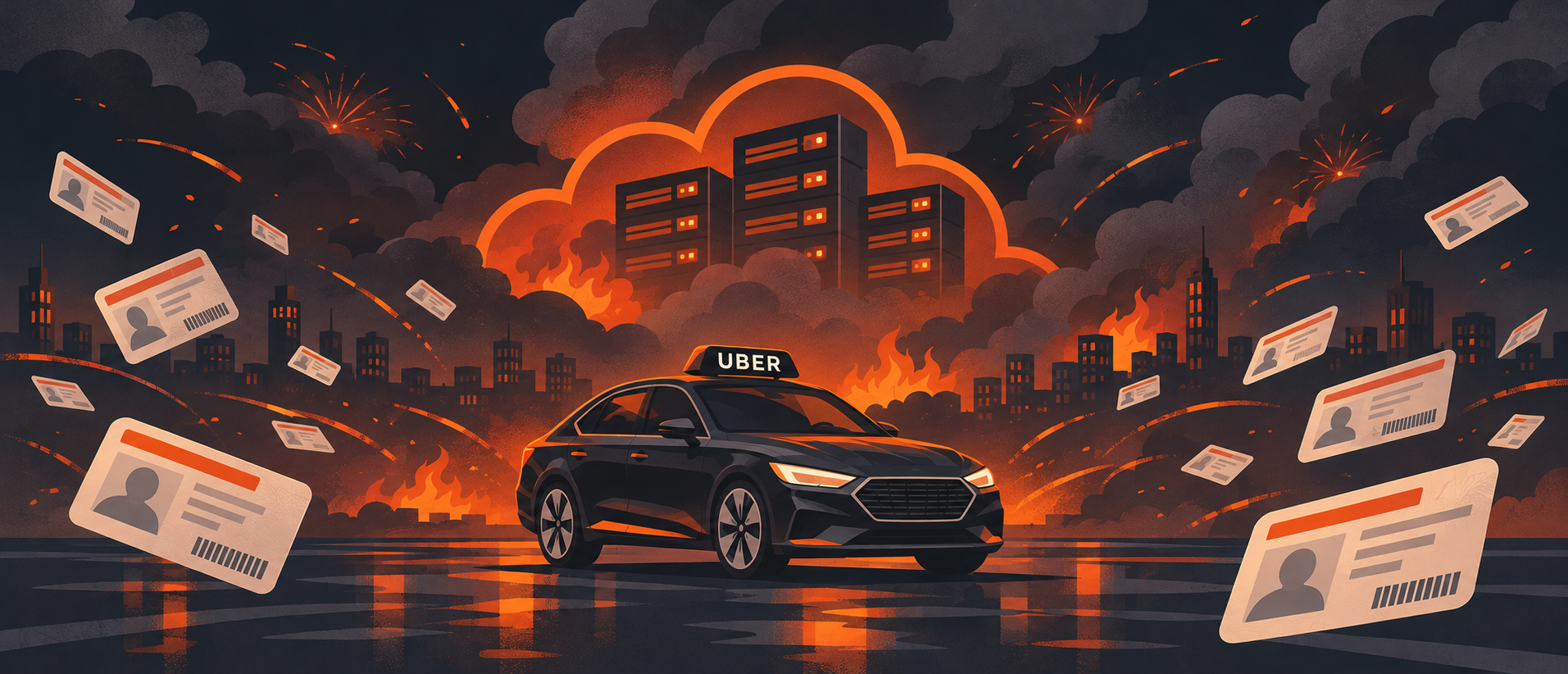
On November 13, TechCrunch reported that Uber was notifying drivers that their personal information and driver's license data had been accessed in an October security incident involving Fireworks AI, one of its third-party technology providers.
By November 16, Uber had told the Texas Attorney General's Office that 149,346 people were affected. The exposed information included names, addresses, dates of birth, driver's license numbers, government-issued ID numbers and images of the licenses themselves.
The important detail is where the data was stored. According to Uber's breach notice, the license files sat in a cloud storage environment Uber set up "specifically to enable the service provider's work," managed by Uber's own cloud security team. Attackers used compromised Fireworks credentials to get into it. Uber's investigation found those credentials were used on October 7, two days before Fireworks notified Uber.
Uber said the vendor's credentials "did not provide access to other Uber systems." That limit matters, but so does the fact that access to one vendor environment was enough to expose the identity documents of nearly 150,000 drivers.
What happened at Fireworks
In short: Fireworks AI, an inference platform for open-weight models with more than 10,000 customers, had two security incidents in October, linked to a group that sells stolen access to AI models. Uber wasn't the only customer affected. Notion disconnected from Fireworks and deleted its data there. Fireworks' incident update covers the technical details.
The attackers were after AI capacity and tokens, but they reached customer data anyway.
Uber's drivers didn't need to know Fireworks existed for their license data to be caught up in a Fireworks breach.
Uber is all-in on AI
Uber is one of the more aggressive enterprise adopters of AI. According to The Pragmatic Engineer, 92% of Uber's developers use agents monthly, 65 to 72% of code in IDE-based tools is AI-generated, and AI-related costs are up sixfold since 2024.
To be clear, nothing in the reporting suggests AI-generated code caused this incident. It didn't come through a vulnerability in Uber's codebase. It came through a vendor relationship and the credentials that gave that vendor access to an Uber data environment.
That's the point. Moving quickly on AI usually means adding AI vendors quickly: inference providers, model hosts, agent platforms, evaluation tools, data-labeling services. Each one may receive data, credentials or both. Each one becomes part of your attack surface the day it's connected to a workflow.
The AI supply chain is a data supply chain
Security teams have spent a decade learning to review SaaS vendors. AI vendors deserve the same scrutiny, with a few sharper questions:
- What data are we sending this vendor, and does it need plaintext to do its job?
- Does it store inputs, outputs or datasets after processing? If so, for how long?
- What credentials or tokens does it hold, and which systems or data environments can they reach?
- If this vendor is breached tomorrow, what do our customers lose?
The last question is the one that matters.
A stolen credential carries whatever access it was granted. A dataset in a vendor-connected environment is exactly as sensitive as the day it was uploaded. Monitoring and least-privilege access reduce the risk, but neither changes the value of plaintext data once an attacker reaches it.
When the vendor needs to see the data
Some vendors do need to read sensitive data. If an AI provider is processing license images, it has to see license images. Encryption at rest won't stop someone holding that vendor's valid credentials.
What you can control is how much is exposed, and for how long. A vendor that needs a batch of documents for a job should get that batch for that job, with access that expires and can be revoked when the work is done. It shouldn't get standing access to an environment holding nearly 150,000 identity documents.
Security teams have a name for this: blast radius. No one can guarantee a vendor will never be breached, but you can decide how much sensitive data a compromised vendor, credential or integration can reach when it happens.
We've seen this pattern several times this year. In June, attackers stole the OAuth tokens Klue used to connect to customers' Salesforce environments and pulled CRM data through the API. Salesforce itself wasn't breached. The same month, a ServiceNow endpoint shipped with authentication disabled, exposing customer instance data. The vendors and mechanisms differed, but in each case what made the incident costly was standing access to data that had accumulated over time.
Uber's case fits the pattern. One vendor credential, one environment, nearly 150,000 identity documents. Beyond asking whether a vendor is trustworthy, ask how much one stolen credential can reach on any given day.
A vendor breach shouldn't be a customer breach
Encryption works alongside vetting vendors, limiting access, monitoring activity and rotating credentials, and it changes what a compromised vendor, credential or data environment can reveal.
The principle is simple: a breach at a vendor should not automatically become a breach of your customers' most sensitive data.
Driver's licenses, financial records and medical documents should stay encrypted end to end as they move through a workflow, and be decrypted only where and when someone needs to read them. They shouldn't sit in plaintext in a vendor-connected environment by default.
That's how SendSafely is built. Data shared through SendSafely is encrypted in the browser using split-key encryption; the Client Secret never reaches our servers. Senders control access after the fact: they can revoke a recipient or delete a package at any time, before or after download. Sensitive files stay protected in transit and at rest, without turning an application database or AI vendor into a repository of plaintext documents.
The same thinking applies to AI agents. SendSafely Halo lets customers share sensitive files during AI-powered conversations without handing them to the AI. The file is encrypted on the customer's device, the agent only posts a secure link, and access goes to the specific people or systems you authorize, with expiration and revocation built in. As we put it then: you cannot prevent every manipulation, but you can control what data the manipulated system can see. The same goes for every vendor in the chain.
The Bottom Line
Uber's drivers were exposed through an AI vendor relationship.
For companies adopting AI quickly, that's the more likely path to a data incident. You can't prevent every vendor breach, but you can limit how far it reaches.
If you're sending sensitive data to AI tools and vendors, let's talk about shrinking the blast radius before the next vendor breach.
SendSafely: Integrated File Transfer for the Apps you Love
If you are looking for a secure way to send or receive files with anyone, or simply need a better way to transfer large files, our platform might be right for you.