
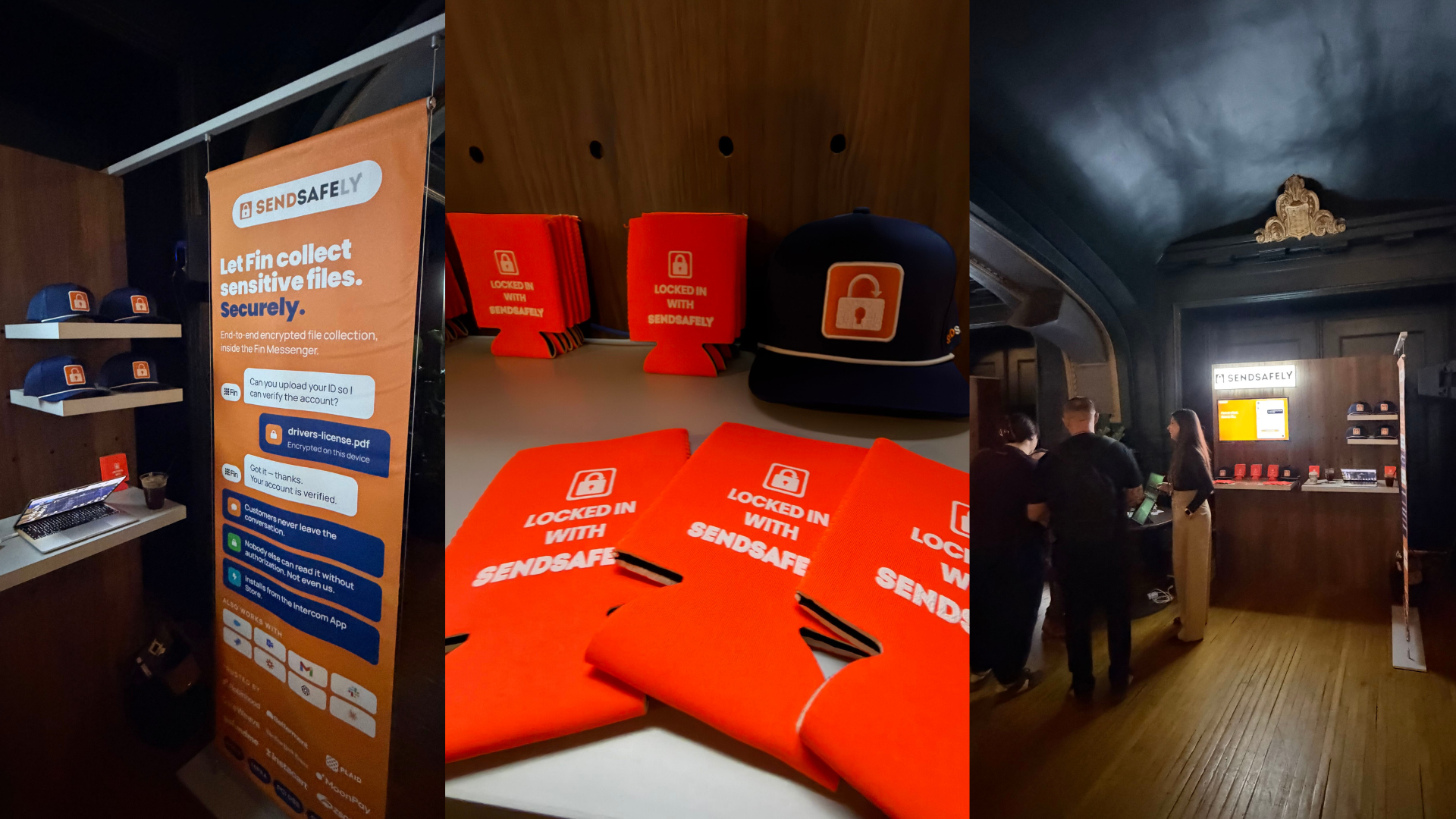
The SendSafely team just got back from Pioneer, Fin’s annual event for teams building AI-first customer service. We had a great time, learned a lot, and spent the day talking to people who are deploying AI agents in production right now.
A theme came up again and again, and it’s a shift worth paying attention to.
The question is no longer just “what are we sending to the AI?”
For the past couple of years, most AI security conversations have focused on the input: what employees paste into a prompt, what customers type into a chatbot. That still matters. But the people we talked to at Pioneer are now asking a second question: once an AI agent has access to your systems, what can it read?
Audit logs. Customer chat transcripts. Conversation history that stays around long after the ticket closes. If a customer shares a bank statement or a medical record in a support chat, that data doesn’t disappear when the conversation ends. It sits in a transcript, and anything with access to that transcript can see it.
Agents want to do harder things
The second theme was ambition. Teams want their AI agents to go beyond answering questions. They want agents that can process payments, execute contracts, and complete multi-step workflows on the customer’s behalf.
Every one of those tasks requires handling something sensitive: a payment detail, a signed document, a credential. The more useful an agent becomes, the more sensitive data it has to touch.
Not every secret an agent touches is one it should have. Some it needs to do its job, like the API credentials you configure so it can work inside your ticketing system. Others it picks up by accident: a customer pastes their own login into the chat to “help,” or shares a screenshot with a session ID in it. That second category should never be within an agent’s reach.
AI agents have repeatedly shown they will use whatever access they’re given to try to solve a problem, often in unauthorized ways that create legal risk. There’s also longer-term latent risk that sensitive data now sits in the transcript, readable by anything with access to it, indefinitely. The goal is to give agents only the secrets they need and keep everything else out of their reach entirely. SendSafely Halo makes that separation possible. Customers share sensitive data through an end-to-end encrypted channel, so the agent can keep the workflow moving without ever reading the data itself or leaving it in the transcript.
Where SendSafely fits
When Fin determines it needs sensitive information from a customer, it can drop a SendSafely upload form directly into the conversation. The customer uploads files or sends a secure message without leaving the chat, and the data is protected with end-to-end encryption from the moment it leaves their device.
The result: sensitive files and details stay out of the chat transcript, and out of the logs an AI or anyone else could later read. Fin keeps the conversation moving, routes the customer to the next workflow or a human agent, and your team gets what it needs without that data spreading across your support history.
Your tools don’t change. Your Fin workflows don’t change. The sensitive data just stops living where it shouldn’t.
Thank you, Fin
We’re grateful for our partnership with the Fin team. The energy at Pioneer was great, and it was clear how invested their team is in the companies building on their platform. We spent a lot of time with them, from their partner team up through their leadership, and we’re looking forward to what we build together next.
See you at Pioneer next year, we promise to bring more hats!
Want to see how the SendSafely integration works with Fin? Request a demo or reach out to sales@sendsafely.com.
SendSafely: Integrated File Transfer for the Apps you Love
If you are looking for a secure way to send or receive files with anyone, or simply need a better way to transfer large files, our platform might be right for you.