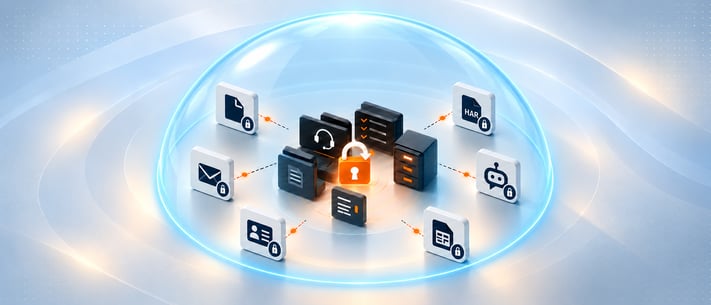
An attacker gets into your customer support platform. How much sensitive information can they reach? The answer depends on decisions made long before the breach: which files were stored there, how long they stayed, and who could access them.
That question runs through Brian Holyfield’s conversation with Tom Fox on Innovation in Compliance. Holyfield, SendSafely’s Co-Founder and Chief Product Officer, spent the first half of his career in ethical hacking, testing organizations’ defenses by breaking in with permission. That experience shapes his approach to protecting data today: plan for what an attacker could reach once a defense fails.
Companies now entrust sensitive information to a network of service providers and connected applications. Even a business that protects its own systems carefully can be exposed through a vendor. Prevention remains essential, but it needs to be paired with deliberate limits on the damage a breach can cause.
What blast radius means for your data
That damage has a useful name: blast radius. In cybersecurity, it describes the extent of the access and data exposure an incident can create. A compromised account that can reach a handful of current files presents a very different risk from one that can retrieve years of sensitive customer attachments.
“Don’t spend so much time asking whether the wall is going to hold. Start asking what’s stacked against the inside of it that’s going to collapse as soon as it falls,” Holyfield says.
How everyday systems accumulate risk
Reducing that exposure begins with understanding what accumulates inside everyday systems. A support ticket may need a sensitive attachment while an agent resolves an issue. Months or years later, the file can still be sitting there because someone thought it might be useful again. Repeat that across thousands of tickets, and the platform becomes an archive of information that no longer needs to be readily accessible.
Attachments deserve particular attention because their contents are unpredictable. A structured field tells you what information belongs there. A file can contain much more than anyone requested, especially when a customer is eager to get help. As those files accumulate, the organization’s exposure can grow without an obvious change to the platform itself.
Connections between systems expand that exposure further. In discussing incidents involving ServiceNow and Salesforce, Holyfield describes several routes to sensitive data: platform vulnerabilities, compromised vendor connections, and compromised user accounts. A trusted connection can give an attacker access even when the underlying platform remains secure.
Long-lived credentials make this especially concerning. An unused integration may retain access after the organization has stopped using the service. If its token is stolen, an attacker can retrieve whatever that connection permits, and the activity may resemble legitimate access. Reviewing connected applications and narrowing permissions therefore belongs alongside reviewing the data itself.
Limiting what a breach can expose
The practical response starts with retention. Delete files when they are no longer needed and can appropriately be removed. Where records must be retained, move them into an archive with tighter access instead of leaving them in a frontline system available to a broad group of employees. Business process owners need to define those rules so employees are not left deciding on their own what is safe to delete.
Leaders also need to look beyond a simple assurance that data is encrypted. Encryption at rest does not prevent a platform from decrypting information for someone using a compromised, authorized account. The useful question is whether an attacker who gains access to the platform can also access the sensitive content.
How SendSafely protects sensitive attachments
This is where SendSafely fits into the approach as a separate trust layer for sensitive attachments used in tools such as Salesforce, Zendesk, and Outlook. Files are handled through SendSafely’s end-to-end encrypted technology, with encryption keys controlled by users. SendSafely itself sees encrypted data rather than readable file contents.
Separating sensitive file storage from the business application reduces reliance on that application’s storage protections while allowing employees to work with files from within their familiar tools. It also gives organizations a way to use those tools for workflows involving sensitive information without placing the attachments directly in each platform’s native storage.
The same principle applies to AI-assisted support. SendSafely Halo allows a chatbot workflow to collect an encrypted attachment without making its contents readable to the AI. An authorized human can then use the file when the conversation is handed off. That creates a boundary between collecting information and allowing another system to process it.
Making secure workflows easy to use
For any of this to work in practice, the secure workflow has to fit the way people already work.
“The moment you try to take somebody out of the system that they live in all day long to do something a little more securely, you’ve already lost,” says Holyfield.
Extra friction encourages workarounds. SendSafely focuses on integrations that feel native so that protecting sensitive files becomes part of completing the task. That usability is part of the security model, because controls only help when people consistently use them.
Every organization should ask: if this system were breached, what is the most sensitive information an attacker could get? From there, examine whether that information needs to be there at all. Every unnecessary copy removed, expired attachment deleted, or obsolete connection revoked leaves less for an attacker to reach.
This article summarizes Brian Holyfield’s conversation with Tom Fox on Innovation in Compliance. Listen to the full episode.
SendSafely Halo: The Trust Layer Between Your Data and Your AI Stack
WIf you are looking for a way to keep sensitive customer data out of your AI stack, or need to limit what any one vendor can access, SendSafely Halo might be the right fit for you.
