In our recent post on vibe coding platforms, we covered the growing security risks in the AI stack. This is the other half of that story: what happens when you connect those platforms directly to your business systems — and to your customer data.
Because that’s where the real risk is. AI adoption isn’t just about building apps faster. It's about wiring external, fast-moving systems built for speed, not security, into your mission-critical business environment, often with broad permissions and visibility.
That’s a supply chain problem.
The recent Vercel and Lovable incidents weren’t just platform failures. They exposed something more fundamental: modern AI systems are deeply interconnected, and risk moves across those connections.
The Vercel breach didn’t start at Vercel. It started at Context.ai — and spread through weak controls, exposed secrets, and over-permissioned integrations. That’s the pattern:
- One compromised node
- One over-permissioned integration
- One path into systems holding sensitive data
When you grant AI platforms access to business platforms — CRM systems, support stacks, file stores — you’re extending your trust boundary to vendors that may not yet be battle-tested. Their attack surface becomes your attack surface, and their security posture has been shown, at best, to be still maturing.
The Real Risk: Permissions
Most teams focus on whether an AI platform is “secure.” That’s the wrong question. The real question is: what can it access? AI tools are increasingly being granted:
- API access to internal systems
- Read/write access to customer data
- Tokens and credentials with broad scope
- Deep integrations across multiple services
In other words, they are becoming privileged actors inside your environment. And unlike traditional vendors, many of these platforms:
- Are newly built
- Move fast and change constantly
- Lack mature security controls and operational history
This is classic supply chain risk — but with faster iteration cycles and deeper access.
Trust Isn’t Binary — It’s Architectural
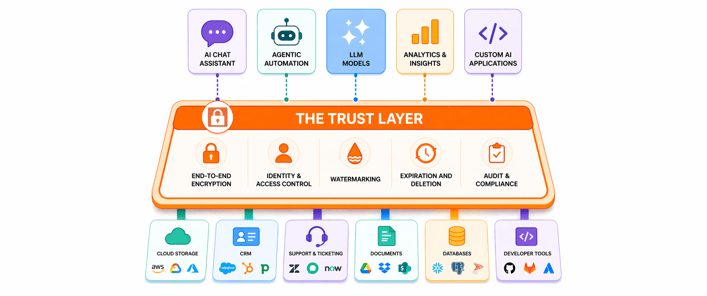
You don’t solve this problem by trying to perfectly evaluate every vendor. You solve it by limiting what any vendor can access in the first place. That’s where a trust layer comes in.
A trust layer sits between:
- Your enterprise systems
- Your customer data
- Your AI ecosystem
It ensures that even if something in that ecosystem is compromised, your most sensitive data is not.
Designing for Containment, Not Perfection
The goal isn’t to assume every platform will fail. The goal is to design so that when one does, the damage is contained. That means:
- Highly sensitive data should not be directly exposed to AI platforms
- Access should be scoped, minimized, and time-bound
- Critical data flows should be isolated from application logic
- Breaches in one layer shouldn’t cascade into another
In other words: limit blast radius by design.
Where SendSafely Fits In
SendSafely provides end-to-end encryption, creating a verifiable trust boundary between sensitive enterprise data and AI infrastructure. It is designed for organizations operating under HIPAA, SOC 2 Type 2, GDPR, FINRA, and PCI DSS requirements.
Importantly, it keeps sensitive data out of your AI ecosystem entirely. So when you integrate AI tools into your workflows:
- They never directly handle raw sensitive data
- Compromise of a platform doesn’t mean compromise of your customers’ files
- Your blast radius is dramatically reduced
For teams building with AI, that looks like:
- Controlled access: AI systems cannot access encrypted data, you control PII access
- Data isolation: Sensitive files live outside the application and hosting layer
- Auditability: Independent logs track exactly what was accessed and when
- Policy enforcement: Expiration, deletion, and access controls are enforced outside the AI stack
The Bottom Line
AI platforms are becoming part of your software supply chain. They move fast. They integrate deeply. And they often require broad access to be useful. That combination is powerful — and dangerous.
You can’t eliminate that risk. But you can contain it.
SendSafely: Integrated File Transfer for the Apps you Love
If you are looking for a secure way to transfer files with customers or business partners, our platform might be right for you. Contact us today to request a demo and free trial subscription.