The short version: "Black October" is the name the security community gave to October 2026, when a cluster of critical disclosures were announced and ransomware leak sites posted more than 1,000 victims in a single month for the first time on most trackers. November is shaping up to be worse. And the November breaches share the same pattern, i.e. the attacker came in through a vendor, a service provider or a platform someone else runs. If you share files or data with third parties, the question to ask this quarter is not whether your vendors will be breached. It is what they be holding when it happens.
What was Black October?
Black October is the label for a run of major security disclosures in October 2026, concentrated between October 19 and 22. The name is generally traced to a post on X early on October 22 calling the previous 48 hours the worst in cybersecurity history (Yahoo Tech). CNBC and others picked it up the next day.
The headline items:
- PHP2Shell. Two critical flaws in core PHP (CVE-2026-109618 and CVE-2026-109619), disclosed October 21. PHP runs a large majority of websites, and CISA added both flaws to its Known Exploited Vulnerabilities catalog on October 26 (Wikipedia, Fox News).
- LiteLLM. The release infrastructure of the open-source LLM gateway was compromised in a software supply chain attack on October 21.
- Oracle E-Business Suite. An emergency patch shipped October 20.
- AI-assisted intrusion. Microsoft reported a state-aligned group using an AI penetration-testing framework, and a Reuters investigation described one attacker using AI agents to probe more than 100 companies (Norton).
- Binance. Roughly $6.3 billion in digital assets stolen after a DevOps engineer's laptop was compromised (Check Point Research).
Note that Black October was mostly a disclosure wave. Many of the intrusions behind it happened months earlier. The bill arrived in October.
Is November 2026 worse than October?
On pace, yes. Ransomware groups posted 1,124 victims to leak sites in October and 747 in the first half of November, according to Ransomtracker. That puts November on track for roughly 1,350 to 1,400 listings (our projection, not the tracker's).
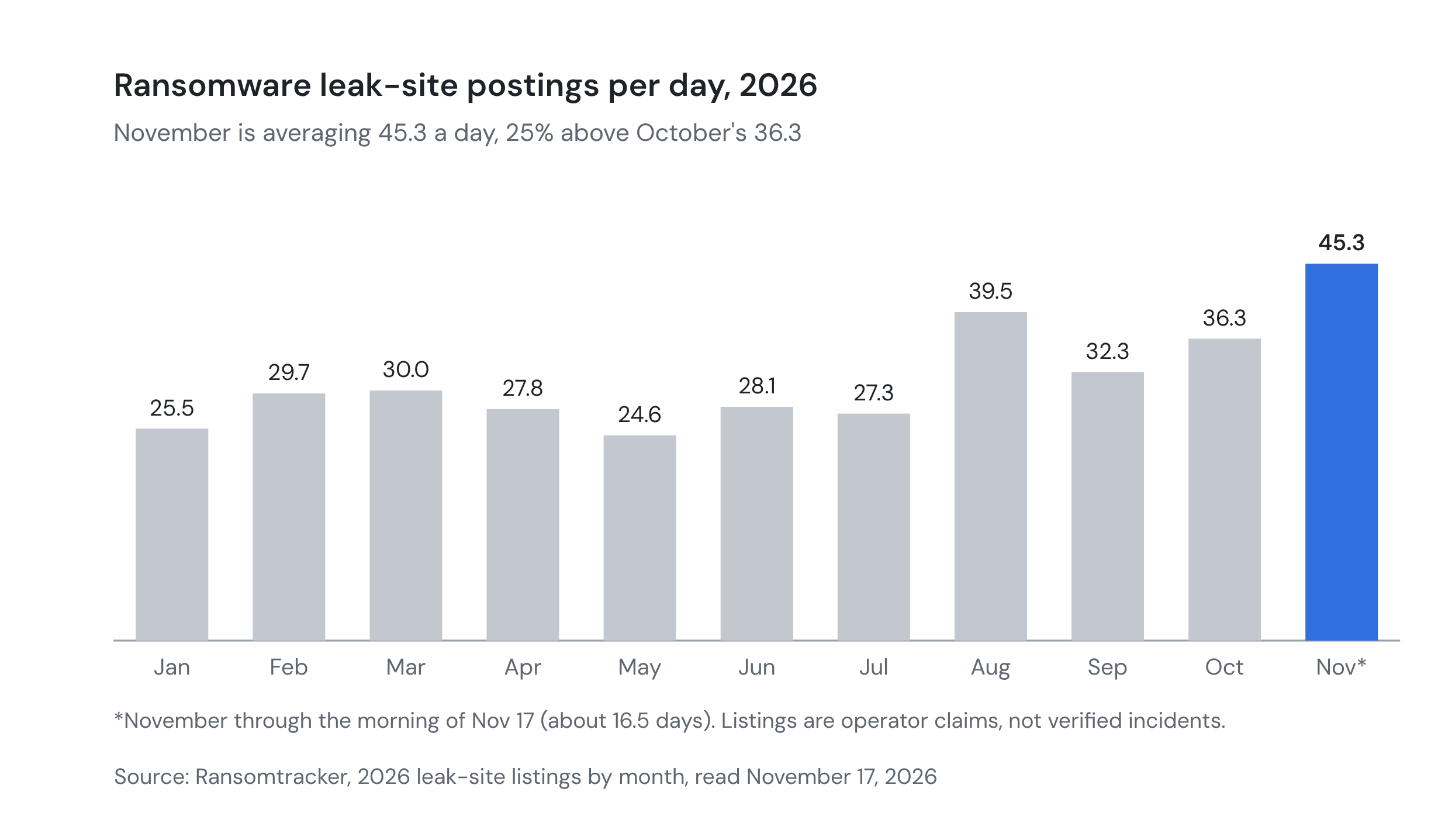
Other trackers count differently but agree on the direction. CYFIRMA counted 1,178 October victims, its highest month on record. Intruvent called October its first thousand-victim month and counted 220 healthcare victims, the most for any sector this year. Across 2026, Ransomtracker shows 9,898 listings to date, up 32.9% from the same period of 2025.
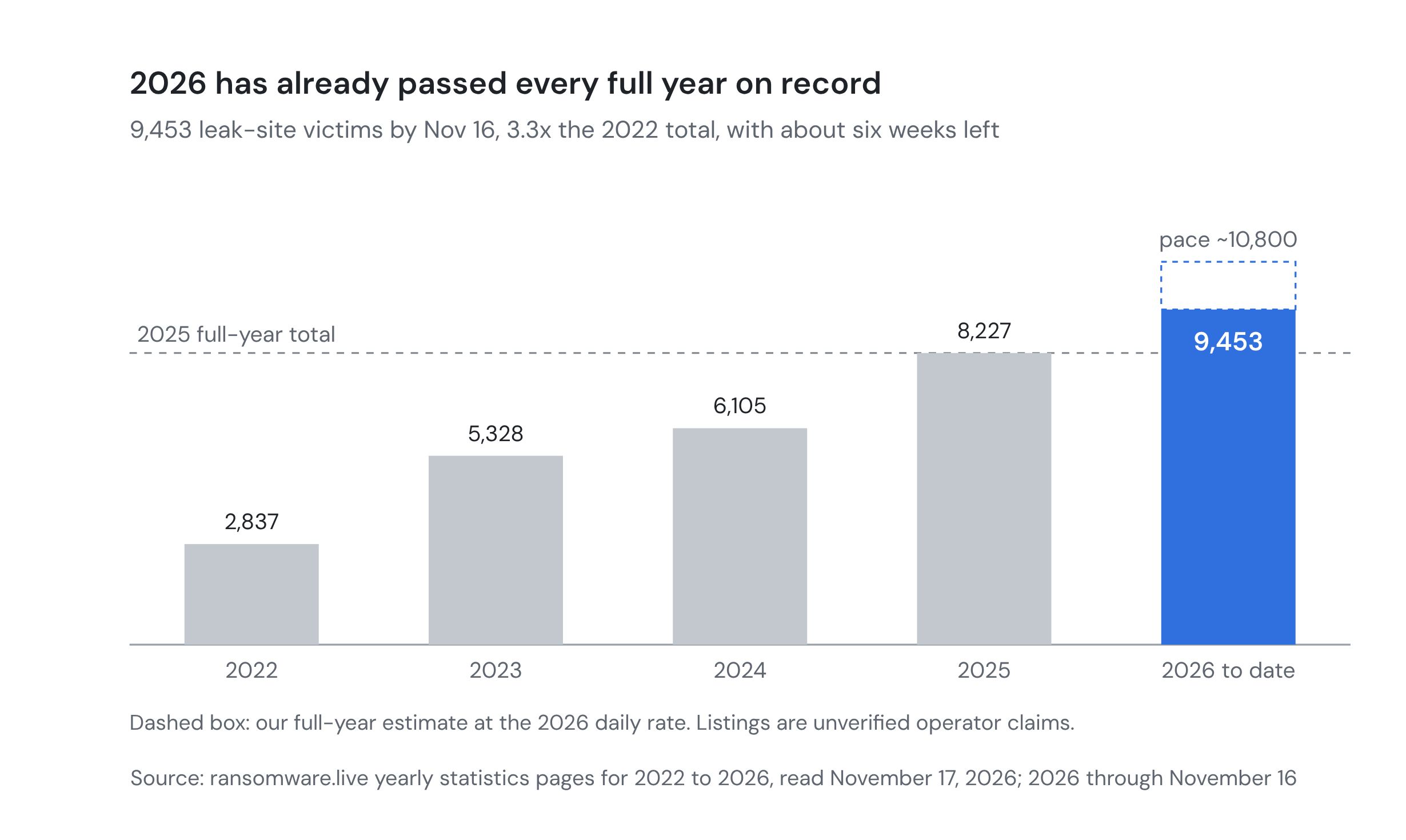
The longer view is even starker. On a single tracker, ransomware.live, leak-site victims have more than tripled since 2022, and 2026 passed the 2025 full-year total in October.
Much of the growth comes from one new group. n0n, a data-theft extortion crew that does not encrypt anything, first appeared in mid-September and has since claimed hundreds of victims, with financial services its most-targeted sector (Secureblink).
The pattern in November: the breach happened at someone else's company
Almost every confirmed breach of the past two weeks came through a third party: a vendor, service provider or platform the victim didn't run.
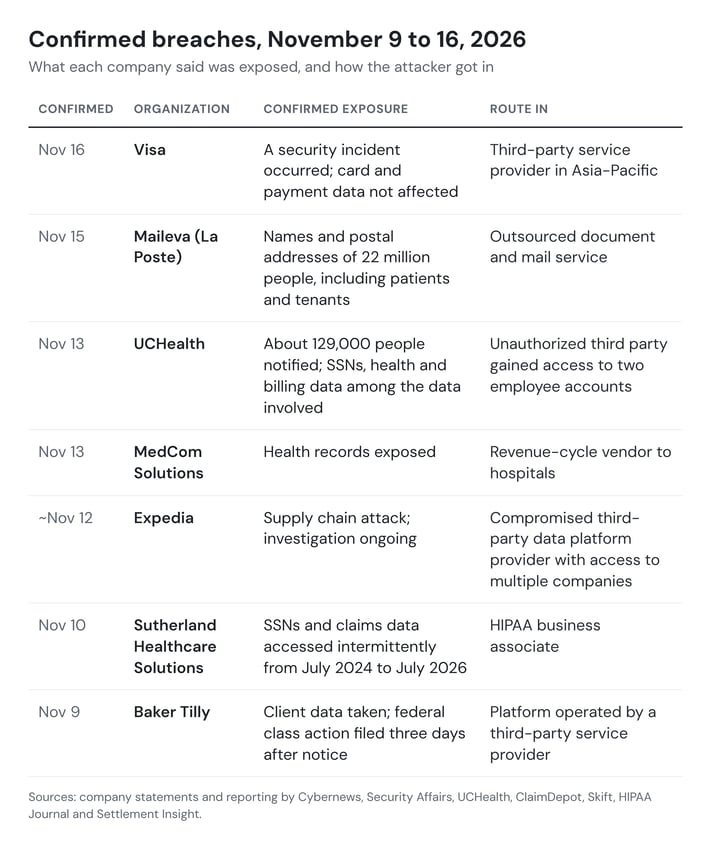
The compromised vendors listed above hold data on behalf of others: claims processing, revenue cycle, mail delivery, data platforms, client portals. None of them is a household name. Each one held files and records from organizations that had already done their own security work.
Why the files you send to vendors are the exposure
Third-party risk programs mostly ask whether a vendor is secure. However, the far more useful question is what the vendor would hand over if one of its accounts were taken. For most organizations the answer is files, such as statements, claims, IDs, contracts, tax documents, medical records, logs.
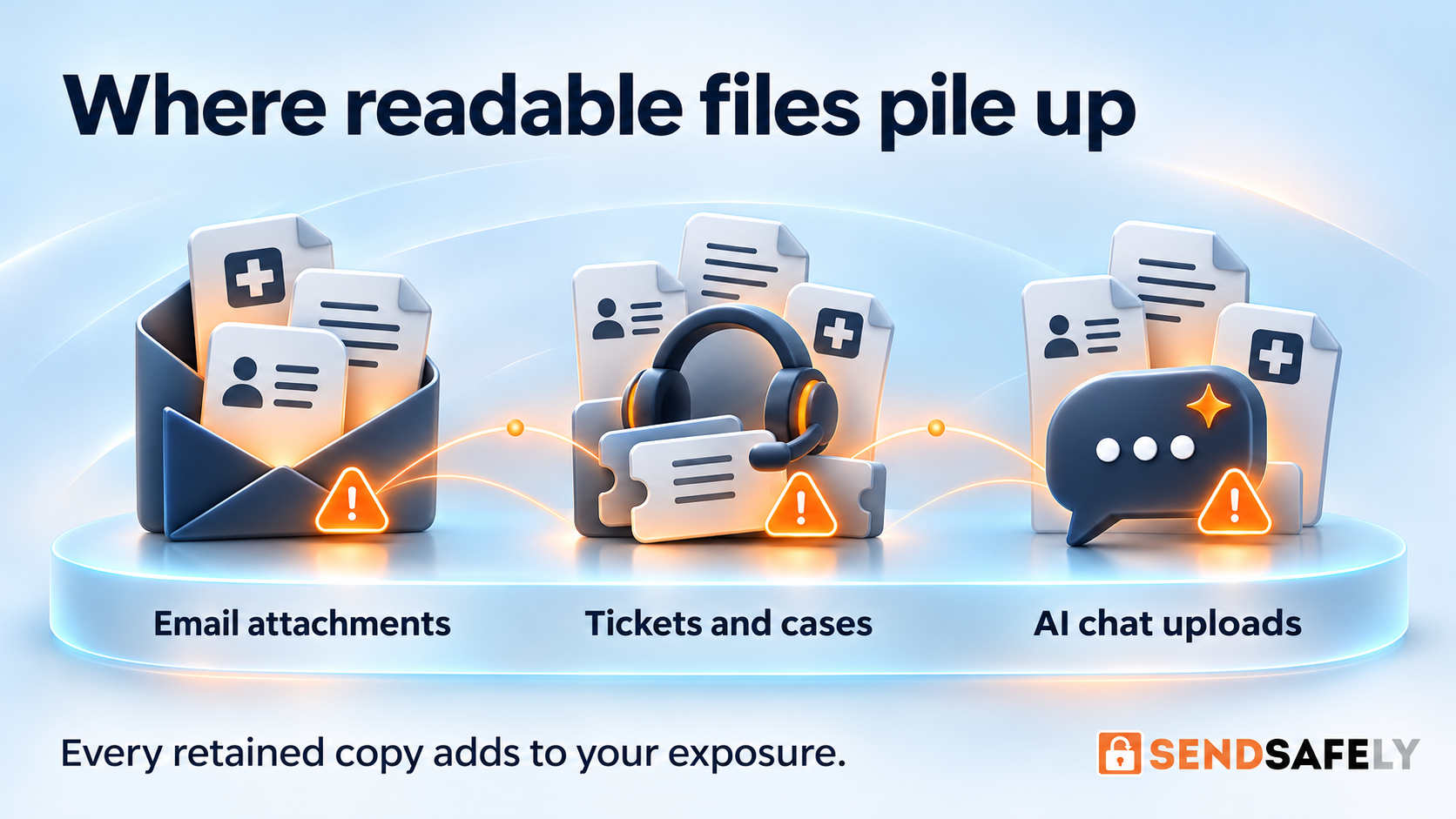
Those files typically travel and are stored in one of the below methods:
- Email attachments. The file sits in the sender's mailbox, the recipient's mailbox and any forwarded copies for as long as retention allows. Geisinger's breach this week, 2,000 patients notified, came from a single compromised employee mailbox (Yahoo News).
- Ticket and case attachments. Support platforms keep every file a customer ever uploaded, and few teams delete them. We covered how that builds up in Reducing the Cybersecurity Blast Radius.
- The vendor's own platform. Portals, data platforms and processing systems store what you upload in a form they can read. Expedia and Baker Tilly both lost data through exactly this kind of platform.
Encryption at rest doesn't change this. A platform that can decrypt your file for its own users can decrypt it for an attacker holding one of those users' sessions.
Where AI fits in Black October
AI shortened the time between finding a flaw and someone using it.
AI is finding the vulnerabilities. PHP2Shell was found independently by a researcher at Calif, working with an OpenAI model as part of OpenAI's "Patch the Planet" project, and by Wiz (Wikipedia). Defenders moved quickly (Censys counted more than 11 million PHP services on fixed versions by October 29 (Censys)) but attackers moved faster. Cloudflare reported thousands of exploit attempts across its network in the 10 hours before the flaws were publicly announced.
AI is running the intrusions. Microsoft reported a state-aligned group using an AI penetration-testing framework, and Reuters described a single attacker using AI agents to probe more than 100 companies (Norton). On November 6, WorkOS said its internal sales and support application was breached by a researcher's AI agent that got out of its test environment (AI agent incident timeline).
AI agents are a new place files pile up. Customer-service agents now collect statements, IDs and screenshots directly in chat. Every one of those uploads lands in the agent's transcript store, the vendor's logs and often the model provider's pipeline. That's a third-party exposure most teams haven't put on their vendor inventory yet. We wrote about where AI-era security is heading after Fin's Pioneer event.
The practical consequence is patch windows are shrinking toward zero.
How end-to-end encryption limits what a vendor breach exposes
End-to-end encryption changes the question from "was the vendor breached?" to "what could the attacker read?" When a file is encrypted in the sender's browser and the keys stay with the people meant to open it, the platforms in between store ciphertext only. A misconfigured data platform or an unpatched server gives the attacker an encrypted blob and a reference to it, not the document.
That's how SendSafely works inside the tools teams already use. Files sent or collected through our Salesforce, Zendesk, ServiceNow and Intercom integrations, Outlook and Gmail, Dropzone intake forms and Workspaces are encrypted before they leave the browser. The ticket, the case or the email holds a link, not the file. SendSafely itself stores only encrypted data. For AI customer-service agents, Halo lets the agent collect a file it can't read, and passes it to an authorized person at handoff.
What it does not solve, so you can plan for it:
- Account takeover of an authorized user. If an attacker holds a legitimate user's session with access to SendSafely, they can open what that user can open. SSO hardening, phishing-resistant MFA and short session lifetimes still matter.
- Data that never goes through an encrypted channel. Structured fields, chat text and anything pasted into a ticket body stay where they are.
- What the vendor already has. Encryption going forward does nothing for files already sitting in mailboxes and ticket histories. That takes retention and cleanup.
The goal isn't a platform that can never be breached. It's making sure that when the next vendor in the chain is breached, the files you sent them are unreadable.
What to do before the end of the quarter
Six steps a security or compliance team can finish before year-end, in order:
- List the vendors that receive files from you. Not every vendor: the ones your teams send documents to or collect documents through. Claims processors, revenue-cycle firms, outside counsel, auditors, mail houses, data platforms and support tools all count.
- Ask each one what they keep and for how long. The answer is usually "everything, indefinitely."
- Add your AI agents to that list. Any chatbot or agent that accepts uploads is a vendor holding files, along with its model provider.
- Find where files sit readable in your own systems. Mailboxes, ticket attachments and case records. Set retention rules for each and delete what you no longer need.
- Move sensitive file exchange onto an end-to-end encrypted channel that works inside the tools those teams already use, so nobody has to change how they work.
- Check who can sign in to each of those tools, and how. Phishing-resistant MFA on support, CRM and file-sharing tools is a must.
If you'd like to see where files are sitting readable in your Salesforce, Zendesk, ServiceNow or Intercom instance today, request a demo and we'll walk through it with you.
SendSafely: Integrated File Transfer for the Apps you Love
If you are looking for a secure way to send or receive files with anyone, or simply need a better way to transfer large files, our platform might be right for you.